2026年5月 · 阅读约需5分钟May 2026 · 5 min read
睡前脑子停不下来?真正有效的方法When Your Brain Won't Shut Off at Night — and What Actually Helps
强迫自己"别想了"是睡前最无效的事。认知科学告诉你什么真正有效——以及当下 App 的银河模式如何把它变成现实。Trying to force yourself to "stop thinking" about tomorrow's problems is one of the least effective things you can do. Here's what cognitive science says actually works — and how Presently's Galaxy Mode puts it into practice.
你经历过。熄灯了,身体躺平了。然后:大脑开始回放今天哪里出了问题。那封邮件你本应该用不同的方式发。有什么事你忘了做。明天有什么事让你担心。大脑似乎打定主意要一直播放直到闹钟响。You've been there. Lights out. Body horizontal. And then: the mental replay of everything that went wrong today. The email you should have sent differently. The thing you forgot to do. The thing you're worried about tomorrow. Your brain, seemingly determined to run a highlight reel until the alarm goes off.
"别想那个了"不起作用——而且有原因的。"Just stop thinking about it" doesn't work — and there's a reason for that.
白熊问题The White Bear Problem
1987年,哈佛心理学家 Daniel Wegner 发表了一项著名研究,证实了一个反直觉的现象:被告知不要想一只"白熊"的参与者,之后反而无法停止想到它——比没有被要求压抑的控制组要多得多。这就是后来被称为"讽刺性加工理论"(Ironically Reactive Processes)的现象,或者更通俗地说——"白熊问题"。In 1987, Harvard psychologist Daniel Wegner published a study that became famous for demonstrating a counterintuitive phenomenon: people who were told to not think about a white bear were subsequently unable to stop thinking about it — far more than a control group who received no suppression instruction. This became known as the Ironically Reactive Processes theory, or more popularly, the "White Bear Problem."
同样的事情发生在睡前的焦虑思绪上。当你告诉自己"别想那个汇报"时,你的大脑监控系统开始积极搜索关于汇报相关思绪的证据——让它们更强烈,而不是更少。压抑的尝试反而放大了你试图避免的东西。The same thing happens with anxious thoughts at night. When you tell yourself "don't think about the presentation," your brain's monitoring system starts actively searching for evidence of the presentation-related thoughts — making them more present, not less. The attempt to suppress amplifies what you're trying to avoid.
真正有效的方法:给担忧一个出口What Actually Works: Externalizing the Worry
有一个经过充分验证的替代方案:给你的大脑一个退出信号。发表在《实验心理学杂志》(APA)上的研究直接测试了这一点。参与者被分配到三个组:写待办清单、写已完成活动的日记、或什么都不做。写待办清单的小组入睡时间显著更快。There's a well-validated alternative: give your brain an exit signal. Research published in the Journal of Experimental Psychology (APA) tested this directly. Participants were assigned to one of three groups before bedtime: writing a to-do list, journaling about completed activities, or doing nothing. The to-do list group fell asleep significantly faster.
📚 睡前写作研究:Bedtime Writing Study: "The effects of bedtime writing on difficulty falling asleep",《实验心理学杂志:总论》(2018)。研究者结论:写待办清单"卸载"了工作记忆中未完成的任务,向大脑发出信号——它们正在被追踪并将得到处理——减少了后台监控的需要。"The effects of bedtime writing on difficulty falling asleep," Journal of Experimental Psychology: General (2018). Researchers concluded that writing a to-do list "offloads" unresolved tasks from working memory, signaling to the brain that they're being tracked and will be addressed — reducing the need for background monitoring.
→ 阅读研究:《实验心理学杂志》(2018)Read the study: Journal of Experimental Psychology (2018)
机制叫"认知卸载"。你的大脑工作记忆空间有限。当担忧在大脑里转圈时,大脑需要主动维护它们——就像保持十几个浏览器标签页打开。写下来就关闭了标签。大脑感知到信息已被处理,释放了它一直在用来监控"未解决"项目的认知资源。The mechanism is called cognitive offloading. Your brain has limited working memory. When worries are circling in your head, your brain needs to actively maintain them — like keeping a dozen browser tabs open. Writing them down closes the tabs. The brain perceives the information as handled and releases the cognitive resources it was using to monitor the "unresolved" items.
🧠 为什么"脑子停不下来"Why "Racing thoughts won't stop"
到了晚上,你大脑负责执行功能和逻辑评估的前额叶皮质正在开始关机。但处理威胁和情绪的杏仁核仍然活跃。这意味着你可以感受到强烈的焦虑,却没有认知能力去评估它是否理性。通过写下来外化你的担忧,有效地"告诉"威胁检测系统:这件事正在被处理。可以停止监控了。At night, your brain's prefrontal cortex — the part responsible for executive function and logical evaluation — is beginning to wind down. But the amygdala, which processes threat and emotion, is still active. This means you can feel intense anxiety without the cognitive capacity to evaluate whether it's rational. Externalizing your worries through writing effectively "tells" the threat-detection system: this is being handled. The monitoring can stop.
银河模式如何运用这个原理How Galaxy Mode Applies This
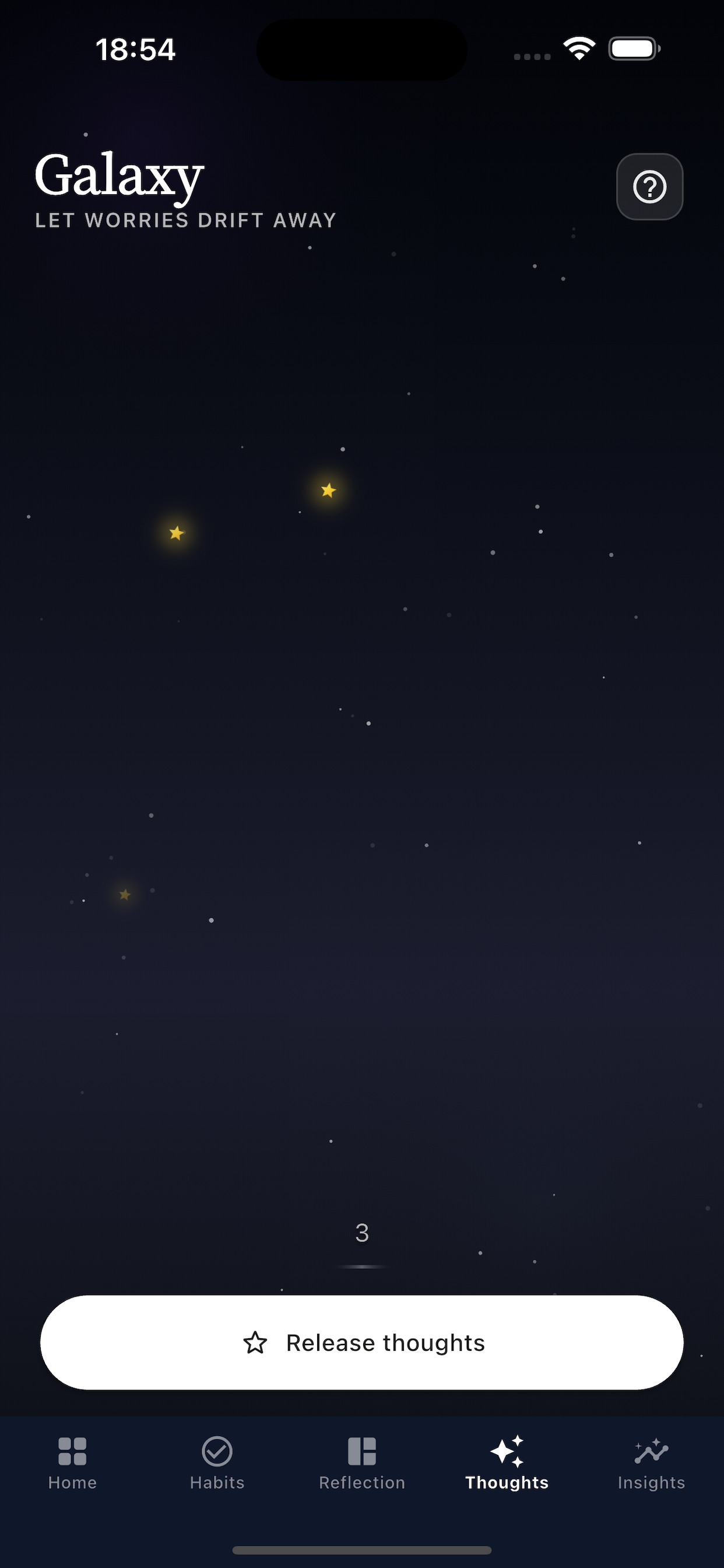
当下的银河模式把这个心理学机制做成了一个有仪式感的体验。不是简单地打一个待办清单,而是引导你把具体困扰你的想法逐条写下来。写完后,触发释放:每个担忧变成一颗星星,消失在银河里。Presently's Galaxy Mode takes this psychological mechanism and adds a layer of ritual to it. Instead of just typing a to-do list, you write down the specific thoughts that are bothering you — one by one. When you're done, you trigger the release: each worry becomes a star and drifts away into the galaxy.
✨ 写下具体的担忧Writing Down Specific Worries
写的动作——不是打字,而看到文字出现的物理行为——创造了更强的认知卸载效果。银河模式引导你写出具体的担忧(不是"工作压力好大",而是"我担心明天的客户电话"),这给了大脑一个更具体的目标去释放。The act of writing — not typing on a notes app, but the physical act of seeing words appear — creates a stronger cognitive offloading effect. Galaxy Mode guides you to write out the specific worries, which gives your brain a more concrete target to release.
🌌 释放仪式The Release Ritual
每个担忧变成星星消失在银河的动画不只是装饰——它是一种行为强化。"放下"的视觉隐喻与"写下来"的身体动作产生关联。随着时间推移,这个仪式本身成为一种条件反射的触发器,让大脑进入平静状态。The animation of each worry drifting away as a star into the galaxy isn't just aesthetic — it's a behavioral reinforcement. The visual metaphor of "letting go" becomes associated with the physical act of writing. Over time, the ritual itself becomes a conditioned trigger for the calm state.
🌬️ 配合呼吸练习效果更好Pair with Breathing
释放完担忧后,使用内置的呼吸练习。深度慢呼吸(特别是4-7-8呼吸法:吸气4秒,屏气7秒,呼气8秒)激活副交感神经系统——身体的"休息和消化"模式——直接对抗让你保持焦虑状态的交感神经激活。After releasing your thoughts, use the built-in breathing exercise. Deep slow breathing (specifically 4-7-8 breathing: inhale 4s, hold 7s, exhale 8s) activates the parasympathetic nervous system — the body's "rest and digest" mode — directly counteracting the sympathetic activation that keeps you in a worried state.
它真的比你想象的更有效It Works Better Than You Think It Will
如果你从未尝试过睡前写担忧,它可能看起来太简单而不会有效。但研究是一致的:效果是稳健的,而且不需要你相信它才会有效。你的大脑对"外化"的反应是自动的,不管你是否确信它会有帮助。给它几晚上感受一下再判断。If you've never tried writing down worries before sleep, it can feel too simple to be effective. But the research is consistent: the effect is robust, and it doesn't require believing in it for it to work. Your brain responds to the externalization whether you're convinced it will help or not. Give it a few nights before you judge.