2026年5月 · 阅读约需5分钟May 2026 · 5 min read
结束一天的方式,和开始一样重要Why the Way You End Your Day Matters as Much as How You Start It
有一个被充分理解的原理,解释了你的大脑为什么在夜里停不下来——而且它有一个名字。理解它会改变你对晚间例程的看法。There's a well-understood reason your brain won't stop at night — and it has a name. Understanding it changes how you think about your evening routine.
大部分夜间反思建议都得到了所有关注。但有一个更安静的问题影响了更多人:无法在夜间停止大脑。躺在床上,回顾一天,预期明天,思维在同一循环里转个不停,直到睡眠最终强行介入。Most morning routine advice gets all the attention. But there's a quieter problem that affects far more people: the inability to stop your brain at night. Lying in bed, reviewing the day, anticipating tomorrow, running the same loop of thoughts until sleep finally forces its way in.
这种体验几乎是普遍的。而原因是令人惊讶地清晰。The experience is nearly universal. And the reason is surprisingly well-understood.
蔡加尼克效应:为什么大脑保持活跃The Zeigarnik Effect: Why Your Brain Stays Active
1927年,心理学家 Bluma Zeigarnik 在一家餐厅观察服务员时注意到一个奇怪的现象:他们能记住尚未完成订单远好于已经完成并送出的订单。这个观察引导出了认知心理学中最稳健的发现之一:未完成的任务比已完成的任务占用更多心理空间。In 1927, psychologist Bluma Zeigarnik was observing waiters in a restaurant when she noticed something odd: they could remember orders that were still in progress far better than orders that had been completed and served. This observation led to one of the most robust findings in cognitive psychology: unfinished tasks occupy more mental space than completed ones.
你的大脑有一个后台进程——有时称为"开放循环"——维护着对未解决任务的认知,直到收到两个信号之一:完成或放弃。没有收到信号,循环就保持活跃。这在白天是有用的:它确保重要任务不会被遗漏。但在夜里,这是让你保持清醒的机制。Your brain has a background process — sometimes called an "open loop" — that maintains awareness of unresolved tasks until it receives one of two signals: completion or abandonment. Without either signal, the loop stays active. This is useful during the day: it ensures important tasks don't get dropped. At night, it's the mechanism that keeps you awake.
🧠 为什么这在睡前很重要Why this matters at bedtime
当你躺下睡觉时,你大脑负责执行功能和计划的前额叶皮质正在为一天做收尾。但监控未解决任务的脑区没有昼夜节律。它保持活跃。所以你感受到焦虑却没有评估它是否理性或有用的认知能力。循环持续运行因为它没有被关闭。When you lie down to sleep, your prefrontal cortex — the logical, planning part of your brain — is winding down for the day. But the part of your brain that monitors for unresolved tasks doesn't have a circadian rhythm. It stays active. So you get the anxiety without the capacity to evaluate whether it's rational or useful. The loop keeps running because it hasn't been closed.
什么关闭了这个循环What Closes the Loop
APA 的研究(在前一篇关于睡前担忧写作的指南中引用)发现,对夜间反刍最有效的干预不是压制思绪——而是给大脑一个完成信号。写下你的担忧,或为第二天写一个简短的待办清单,有效地告诉大脑:"这件事正在被追踪,将得到处理。"监控过程可以撤退。Research from the APA (referenced in the previous guide on bedtime worry writing) found that the most effective intervention for nighttime rumination isn't suppressing thoughts — it's providing the brain with a completion signal. Writing down your worries, or writing a brief to-do list for the next day, effectively tells the brain: "this is being tracked and will be handled." The monitoring process can stand down.
📚 关键研究:Key Study: "The effects of bedtime writing on difficulty falling asleep",《实验心理学杂志:总论》(2018)。研究者发现,睡前写简短的待办清单显著减少了入睡时间,比写日记和什么都不做都有效。机制:从工作记忆中卸载未解决的任务。"The effects of bedtime writing on difficulty falling asleep," Journal of Experimental Psychology: General (2018). The researchers found that writing a brief to-do list before bed significantly reduced sleep onset latency compared to both journaling about the day and doing nothing. The mechanism: offloading unresolved tasks from working memory.
→ 阅读研究:《实验心理学杂志》(2018)Read the study: Journal of Experimental Psychology (2018)
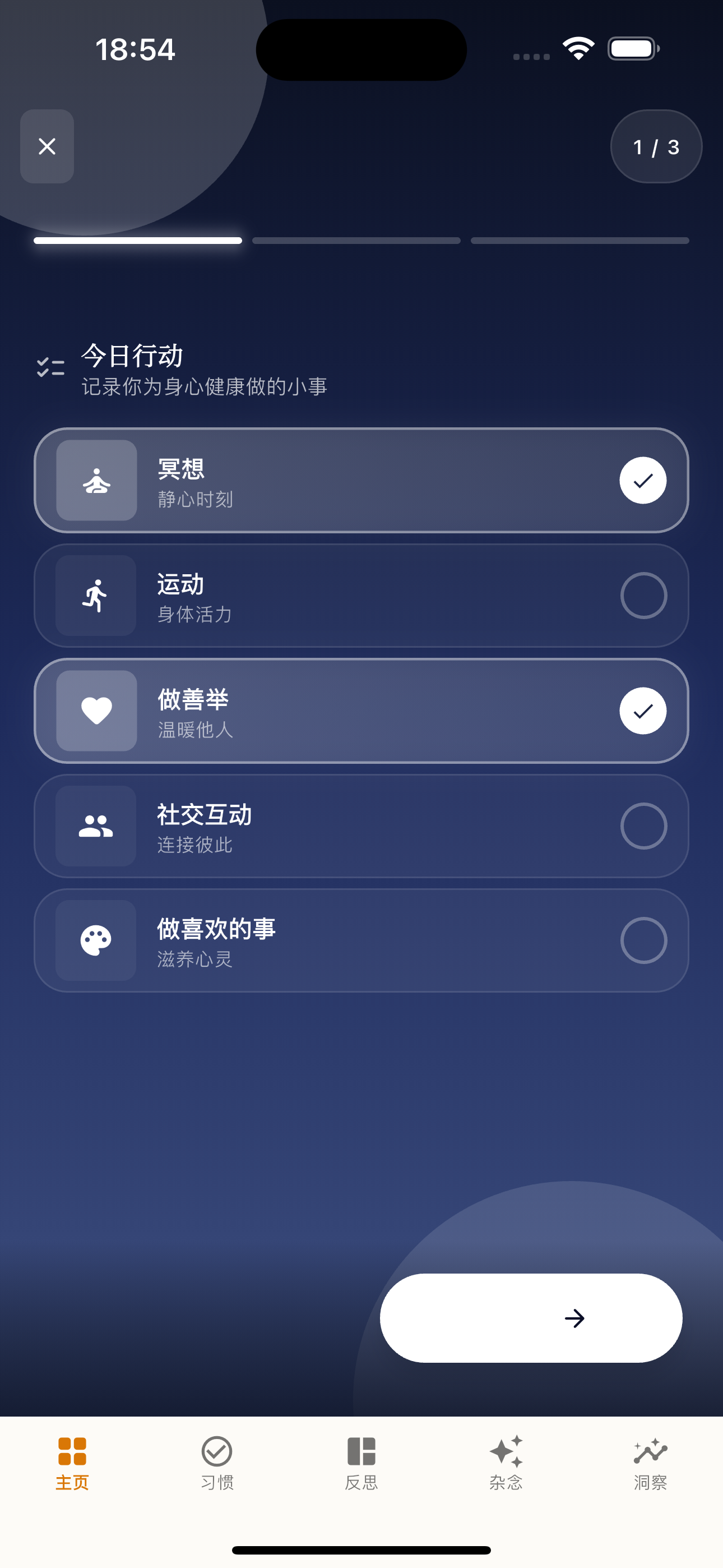
当下的夜间反思功能应用了同样的原理——但用更宽的框架。不是简单地写待办清单,它引导你做一个简要的当日回顾,这服务一个不同的目的:它给你一个关于今天实际发生了什么事的闭合感。Night reflection in Presently applies this same principle — but with a broader frame. Rather than just writing a to-do list, it guides you through a brief review of the day, which serves a different purpose: it gives you a sense of closure on what actually happened today, not just what needs to happen tomorrow.
夜间反思功能做什么What the Night Reflection Feature Does
🌙 日总结Day Summary
App 会展示你今天所有的打卡记录——一个快速的可视化回顾。这不是分析,只是看见:这一天大概是什么样子?通常,光是这一点就很清楚了——你意识到这一天感觉比数据暗示的更难,或者反之。The app surfaces your check-ins from the day — a quick visual review of your mood and energy at different points. This isn't analysis. It's just seeing: what kind of day was it, in broad strokes? Often, this alone is clarifying — you realize the day felt harder than the data suggests, or vice versa.
⭐ 日评分Day Rating
给今天1-5星评分。不是评价你做得好不好——只是一个关于这一天整体着陆感受的感觉。这是今天的循环的完成信号。你已经认可了。它被记录了。它可以关闭了。Give today a 1-5 rating. Not an evaluation of whether you did well — just a felt sense of how the day landed overall. This is the completion signal for the day's loop. You've acknowledged it. It's recorded. It can close.
✨ 一个亮点A Highlight
记下今天发生的一件好事。可以很小——一杯好咖啡,一段安静的时光,你完成的一件事。这是一种对注意到什么在运转的认知偏差的练习。研究一致表明,以积极反思结束一天——无论多简短——都能改善睡眠质量和第二天早晨的情绪状态。Note one good thing from the day. It can be tiny — a good cup of coffee, a moment of quiet, something you accomplished. This is a practiced cognitive bias toward noticing what's working, not just what's not. Research on positive affect and sleep quality consistently shows that ending the day on a note of positive reflection — however brief — improves both sleep quality and next-morning mood.
📋 明天最重要的一件事(可选)Tomorrow's Focus (Optional)
如果明天有一件事已经占据了心理空间,把它写下来。一件事。这是研究显示能减少入睡时间的那种待办清单——在你躺下前就把开放循环卸载。If there's one thing tomorrow that's already occupying mental space, write it down. One thing. This is the to-do list that the research shows reduces sleep onset time — it offloads the open loop before you even get into bed.
过渡本身才是仪式The Transition Is the Ritual
夜间反思有效不是因为任何一个单独的组成部分——而是无缝过渡的行为本身。你在告诉你的神经系统:这一天结束了,这个空间是留给休息的。如果有意识地持续几周,这个过渡就成为一种放松的条件反射触发器。What makes the night reflection effective isn't any individual element — it's the act of transition itself. You're telling your nervous system: the day is over, this space is for rest. Done intentionally, over weeks, this transition becomes a conditioned trigger for relaxation.
大多数人都用刷手机直到睡着来做这个过渡——这向大脑灌输了刺激性蓝光和参与,让放松更难,不是更容易。夜间反思用一个有意义的东西替代了那段时间。它需要3-5分钟,它改变了睡前的感觉。Most people do this transition by scrolling their phone until they pass out — which floods the brain with stimulating blue light and engagement that makes relaxation harder, not easier. The night reflection replaces that with something purposeful. It takes 3-5 minutes and it changes what bedtime feels like.
如果你因为脑子停不下来而睡眠困难,试试这个一周:睡前最后30分钟不碰手机。改做夜间反思。给研究一个机会来验证。If you've struggled with sleep because your brain won't turn off, try this for a week: no phone in the final 30 minutes before bed. Do the night reflection instead. Give the research a chance to work.